Wednesday, May 1, 2019

Tennessee Education Voucher Bill--Were Germantown taxpayers sold down the river by Brian Kelsey and others?

I don't have a copy of the school voucher bill that has been passed by the state legislature, but as explained to me, the bill has the ultimate potential to cost the award winning Germantown Municipal School District millions of dollars--dollars that will likely have to be made up by City taxpayers in the future. And that apparently could happen without a single student opting to leave the system in favor of using a voucher for a private school!

While Sam Stockard of the Daily Memphian asked the right questions of Brian Kelsey and other Republicans, he may not have asked all the right people. From the Daily Memphian   


Asked if funding for the Germantown Performing Arts Center amphitheater, known as the Grove at GPAC, was a reward for his vote in support of the governor’s education savings account bill on Thursday, Kelsey said, “I find that to be a highly offensive question. We don’t operate that way.”

Furthermore, according to the paper, "Republican leaders" reported that such trade-offs do not go on with important bills.

Oh, really? Sometimes all we need to do is look at some different reporting. According to 
Pork or politics? Behind the scenes as Tennessee voucher-backers lobbied House members to pass bill  in the Nashville Tennessean, both David Hawk-R of Greeneville and Bob Ramsey-R of Maryville, who voted against the voucher bill, reported being approached and asked what they wanted in exchange for their votes.   

Do we believe the anonymous "Republican leaders" sources reported in the Daily Memphian, or do we believe the named Republican sources in the Tennessean who voted against the voucher bills? 


And, if Brian Kelsey did not get a little something (such as a $2.5 million dollar grant for GPAC) in return for his vote, wasn't he being remiss in his representation of Germantown?

Brian Kelsey's largest campaign contributions can be found here. One thing I noticed is that the largest contribution, $11,000, was from BOW-PAC, a PAC started by Bo Watson, a state senator from Chattanooga. Is this pot of money just another way of keeping Republican legislators in line? Reading between the lines, it appears so from this article.  Oh, and guess what? Yet another Republican state senator, Yager, R-Kingston, has his own PAC, KEYPAC, which contributed $5,500 to Kelsey. Apparently it is a "thing" now for Republican Senators to have their own PACs.  Where is all this money coming from? In 2011, Bill Haslam signed a bill allowing corporate contributions to PACs.

Kelsey also received $5,450 from "The American Federation for Children", a pro-voucher organization.  StudentsFirst PAC contributed $5000 to Kelsey. StudentsFirst was begun by Michelle Rhee, the controversial ex-leader of Washington DC schools, and an advocate for school vouchers. Tennessee First, a PAC started by two lobbyists, gave him $3000.


In a post on Twitter, Gabby Salinas, who lost a close election to Brian Kelsey, reported that the only votes that Kelsey made against school vouchers was in an election year.

Now it is up to the citizens to decide: Was our award winning GMSD sold down the river 
by Brian Kelsey in favor of a single grant to GPAC? 

There are plenty other characters to blame in this mess, mainly Governor Bill Lee, who it seems forced this bill on only two counties, Shelby and Davidson. Guess what? The rural counties know better than to starve their school systems of funding. 

Gabby Salinas in her Twitter account pointed out that a clause was added to the bill which disallows lawsuits against the state by Boards of Education over this bill. That clause likely will be tested in court if this passes.

House votes (from Salinas Twitter account)
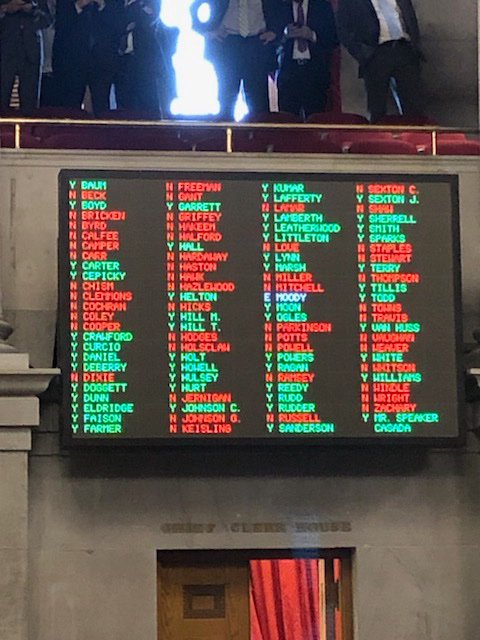


The bill goes to a conference committee now, as different versions were passed by the House and Senate.

Thursday, April 25, 2019

Dogwood Cell Tower Foes Fighting Powerful Financial Interests


Thanks to recent news coverage of the City by mainstream sources, I have been able to continue to take a bit of a breather with this blog. In particular, Abigail Warren of the Daily Memphian must be commended for going the extra mile by attending many of our various commission meetings. Corrine Kennedy of the Commercial Appeal has authored informative articles about the Germantown Country Club property. I recommend that citizens consider supporting both the Commercial Appeal and the Daily Memphian by purchasing online subscriptions. Please also make it be known that you appreciate the local coverage. 
For now, I will not concentrate on breaking news but on commentary or in-depth reports of issues that interest me. 

 Mixed Feelings Among Residents Near Planned Dogwood Cell Tower in the Daily Memphian fits the bill as an issue that interests me.  

The cell tower has passed all levels of approval except the development contract, which will be voted on by the BMA in May.  

While I, too, have mixed feelings, I sympathize with the parents that do not want the cell tower to be located on the Dogwood school playground. Many want it relocated to another part of Dogwood Park, and still others say a cell tower should not be in a residential neighborhood at all. Due to the financial interests, the need for better cell coverage, and the lack of other locations for the tower, the parents should probably hope for the tower to be moved to a different part of Dogwood Park.

Before I discuss specific financial interests in Germantown, I will provide some background. 

First let's take a look at the location: See the red X. I am told that the footprint is large enough that the field day at Dogwood will be affected. It is less than 200 feet from the school. The area is already marked off, so you can stop by and take a look at the area.

I have read that GMSD will receive about $22,000 per year for the lease of the land. Many parents state that if this tower is placed in this location, they will either home school their children or send them to private school. If as few as three children are removed from GMSD because of the cell tower, the funding lost from the state will be greater than the financial gain from the tower. 

The petition against the cell tower at Dogwood has collected over 500 signatures.  

In September 2018, the measure to approve the cell tower at Dogwood was approved by the GMSD Board, with little fanfare and no objections. Jason Manuel notes that cell coverage in the area is poor, and concerning. He also states that the location was vetted by neighbors and stakeholders. Most likely the surrounding neighbors would prefer that the tower be close to the school and away from their backyards. I note here that I have no personal knowledge of the negotiations or players involved. My question would be, were the families of school children at the discussion table? For instance, was the PTO of Dogwood School asked for any input?


The vote was unanimous to allow Tower Ventures to put a cell phone tower on the Dogwood playground.  Let this be a lesson to all Germantown citizens-- please do your best to follow the online posted agendas of meetings, so that you can voice your opinions at the earliest opportunity.  


Since that September passage, a much publicized event has heightened the concerns of parents. There were a number of children and teachers diagnosed with cancer at a school in Ripon, California, and due to the concerns of parents--hundreds stormed the school board meeting-- a cell tower was removed (Sprint Tower Removed, Soil Also Being Checked). The Ripon health issues could be due to an old Nestle plant that polluted the groundwater, but cell tower radiation is also being investigated as a possible cause. But a tower testing the newer, not-yet-rolled-out 5G technology at San Diego State several years ago almost certainly relates to cancer cases. You can see this news report for more details. Many of the victims centered around activities near a certain room on campus. The little-studied 5G technology that will soon line our sidewalks will allow us to use self driving vehicles, have "smart" homes, etc.  At the latest BMA meeting, a qualified citizen spoke about the dangers of 5G technology, and after him, other concerned citizens spoke against the cell tower as well:  


Much of the science on "non-ionizing" radiation, the type emitted by cell phones, cell phone towers, and wireless routers, is controlled by the industry. This is particularly true in the USA. It is telling that the scientists here who are most vehement about the possible dangers of the technology generally have "Emeritus" (retired) in their titles. They are thus immune to the wrath and power of the wireless industry. Consider the experience of Henry Lai of the University of Washington. He found DNA breaks in rats from non-ionizing radiation: UW Scientist Henry Lai Makes Waves in the Cell Phone IndustryAnd yes, the industry attempted to have him fired from his job: 

After Lai and Singh’s research finding an effect on DNA was published in 1995, Lai learned of a full-scale effort to discredit his work. In an internal company memo leaked to Microwave News, a publication that examines health and environmental effects of electromagnetic radiation, Motorola described its plan to “war-game” and undermine Lai’s research.

Lai was shocked by the war-game memo, and calls for more research. All his research funds looking into non-ionizing radiation dried up. He advocates a precautionary approach to the technology: 

"European countries generally believe you need some kind of precautionary approach,” says Lai, who does not own—or use—a cell phone. “What else can we do? Obviously, we don’t know the answer at all. But, then, there is a cause for concern. We need to take some kind of precautionary action.” 

Brussels. Belgium, in a "precautionary action", has banned the newer 5G technology until studies on health can be done.  

An example at the power of the cell phone industry is found in 1996 federal legislation. 

No State or local government or instrumentality thereof may regulate the placement, construction, and modification of personal wireless service facilities on the basis of the environmental effects of radio frequency emissions to the extent that such facilities comply with the regulations contained in this chapter concerning the environmental effects of such emissions.


According to Director of Economic Development Cameron Ross, speaking in the 
 February meeting  (link to video) of the Planning Commission, the only allowable reason to reject a request for a tower is aesthetics. The Planning Commission Chair used that as a reason to attempt to censor citizen-speakers who wanted to focus on possible health issues.  It is also important to note here that there are also safety concerns due to the lack of cell coverage in the area, which are noted in the meeting by two citizens that favor the tower. They point out that health monitoring devices are sometimes dependent on coverage, and children need to be able to use their cell phones for safety reasons. However, developing children and pregnant teachers are those potentially most at risk from the technology being present within 200 feet of a school. The citizens who are against the tower location realize that they are prohibited by law from using environmental radiation concerns as an issue to disallow the tower, and are now concentrating on talking about the legitimate concerns of possible declining home values in the Dogwood Elementary School zone. According to Cameron Ross, though, home values are also not allowed as a reason to disallow the tower, due to a sixth Circuit Court opinion. I have not looked at the court cases. A recent decision by the California Supreme Court upheld a San Francisco ordinance which requires towers to pass an aesthetics test.

About a year ago even more draconian federal laws about the placement of the newer 5G towers were passed. As a result, small 5G towers will be lining our sidewalks soon. Generally websites either point out the opportunities of 5G networks, or the risks, but rarely both. European explanations of 5G, such as this, are the only sources that I feel comfortable linking to explain the technology, because it points out the benefits as well as the real potential risks. Municipalities are now virtually forced to allow the new 5G towers on utility poles. The new 5G rules, along with the 1996 Act, were the drivers of a recent City ordinance change 
(Ordinance 2019-6) to the Wireless Transmission ordinances. This change removed the decisions on cell tower location from the elected BMA.  Here is the November 6 Planning Commission discussion of the ordinance:  


Dean Massey was the only alderman who voted against this ordinance change when it came before the BMA earlier this year. He has been posting articles about the possible health concerns of 5G networks (such as this) on his Massey for Germantown Facebook page. He feels that the science is not definitive and he does not want school children to become guinea pigs.

The upshot of the new federal and state laws is that municipalities are severely limited in their ability to disallow or even control the placement of the coming 5G technology. The industry will be able to seek approval for up to twenty towers at a time, and there is a strict limit on the amount of time a municipality has to disapprove a tower, and very little leeway to turn down an application!  We will soon be swimming in frequencies that have very little scientific study.    


It is powerful financial interests that drive federal law, state law, and funding for scientific studies. These interests also likely donate heavily to otherwise trusted 501(c)(3) organizations that purport to combat various diseases.  As a result, these organizations may spin the research results in ways that favor the industry. For that reason, I steer clear of using 501(c)(3) organizations as a source of good overall interpretation of scientific studies. 

The tentacles of the cell phone industry also reach deep into Germantown political circles. Here is the "team" at Tower Industries: Tower Ventures website  


Here are 2018 Tower Ventures team's donations to Germantown administration-supported politicians through September 30 of last year: 
  
Mayor Mike Palazzolo


Craig Weiss, Principal $1000.00
Steve Chandler, Executive VP $1500.00 

Sharon Chandler (wife) $1500 
William Orgel $1000
 

To Mary Ann Gibson: 

Steve Chandler Executive VP $500 
Sharon Chandler (wife) $500 
William Orgel President $1000
Craig Weiss Principal $1000 


To Brian White:

Steve Chandler, Executive VP $1500 
Steve Chandler, Executive VP $500 
Michael McLaughlin, Controller $100 

To the Germantown "Values" PAC (see Oct. 21 2018 post)

Steve Chandler $1500  


*******

Additionally, Controller Michael McLaughlin sits on the Financial Advisory Commission and the Industrial Development Board.


Monday, April 8, 2019

City Administration Wants Sanitized BMA Meetings and Censorship of Minority Aldermen Voices

In a blatant post-election anti-transparency move, the City administration is proposing actual censorship at BMA meetings. Aldermen in the minority on issues will be effectively censored from voicing objections to certain measures if a proposed resolution is passed in the BMA meeting tonight. Currently, items that are considered routine are all put in a consent agenda, and voted on as a group, with no discussion. All five aldermen must agree before items put to a vote are placed in the consent agenda. Proposed Resolution 19R05 changes all that, and votes of only three of the five aldermen are able to place items in the consent agenda. Take a look: 


Items that have ANY objection by ANY aldermen are by definition not routine. The people can judge from 
the ensuing discussion if aldermen attempt to put routine items in the regular agenda.  Relabeling the consent agenda as the preliminary agenda is nothing but a ploy.

This is a blatant attack on transparency. The people do NOT want sanitized meetings, we want open discussion of each item if there are any objections by any of the aldermen.  


Aldermen, PLEASE do not pass this measure.

Wonder what else the citizens will have to endure next?

Friday, March 22, 2019

Three Public Hearings at Monday March 25 BMA Meeting


Every BMA meeting has a "Citizens to be Heard" agenda item, where members of the public may voice their opinions on various subjects. Separately, changes in ordinances require that public hearings be held. Ordinance changes require three readings, and the second reading always includes a "public hearing". There is a three minute time limit for speaking at the public hearing. Three ordinances will be read for the second time this coming Monday; thus, there are three public hearings.

The meeting notice is here: 


The public hearings:  


The entire red-lined parkland dedication fee ordinance change is found here:   


City Description:

Although I support the idea of public parks, I have serious concerns that, as written, this ordinance may be unconstitutional. It is a "fiscal impact fee", and, as such, the fee may not be used for the benefit of the general citizenry, but only for items that the project impacts directly  If a developer is charged a fee for parkland dedication, the fee must be "roughly proportional" to the usage of the park by the residents of the development.  On February 27, I wrote an email to the aldermen explaining my position: The entire email is linked here. An excerpt:

I suggest the inclusion of additional language along these lines: “In determining the amount of the fee to be charged the developer, the City will consider the distance from the new residential project to the newly acquired parkland, or to the existing parkland to be improved, and ensure that the developer is charged a a fee that is roughly proportional to the anticipated usage of the parkland by the residents of the new project.”

Additionally, this ordinance shifts power from the citizen led Park Commission to the City Administration (Parks Director), and I oppose that portion of the legislation. 

I discussed my concerns previously at the Planning Commission Meeting (see my November 11 post).  


The entire tree ordinance is found here:   


I previously discussed some of my issues with the proposed tree ordinance at the Planning Commission Meeting (discussed in my November 11 post). Fortunately one of my major concerns has been addressed, because at least the mandatory nature of the "maximum" fee a development must pay has been eliminated. Now, the maximum has conditions, and must be approved. 

My other concern-- that these fees could be used for storm cleanup which ordinarily would be charged to operating expenses-- remains.

Overall, now that the maximum fee concern has been addressed, the City is better off having this ordinance change than not, although I certainly would have written it differently. 


The entire proposed purchasing ordinance is found here:  


The Administration explanation:   

 
Increasing the limit for public advertisement and competitive sealed bids from $10,000 to $25,000 is more efficient, but does it save the City money? Yes, the State now allows the City to make this change, but there is no requirement to do so. Additionally, there is less transparency when the BMA does not vote on these contracts.


Tuesday, March 19, 2019

Mayor Decides on Legislative Agenda Without Consulting BMA


On March 1, Mayor Palazzolo wrote the following letter to the Germantown state legislators, setting out the "official" positions of the City on proposed bills, (
For those that cannot easily read the images below, the PDF of this memorandum can be found here.) 


Unfortunately (and incredibly) the BMA has not been asked to give its input on the legislative agenda.

At the recent BMA retreat, (see March 6 blog post)  the general subject of the legislative agenda was discussed, but details only included information on the online sales tax. Alderman Massey specifically asked that the BMA discuss the full legislative agenda, and the Mayor sounded amenable, although he made no specific promises.   

  
Partial Quote: (listen starting at 14:23 for the entire exchange)

Dean Massey: "It would be good to get the opinion of the Board on some of these so we can direct the lobbyist............."

Mayor Palazzolo: "I understand that.......Sure."

Mayor Palazzolo goes on to explain that sometimes there is not time to consult the BMA.   

**********

I am not sure I have enough information about the specifics of each item to definitively state that I either support or oppose specific proposals, but all of the items that the administration opposes particularly interest me. The public needs to hear discussion and debate on these (and all other) items. My gut reaction is to strongly favor the measures that the administration opposes. At the very least I would love to hear the pros and cons at a BMA meeting. And certainly it should be the BMA that sets the legislative agenda, not the Mayor alone.  I briefly discuss three of the proposals below. 


***********


SB0600 requires that municipalities have a secure method for bids to be accepted electronically. The text of this bill is found here: 


The administration gave no reason for opposing this, and it seems like a great idea to me. The City might even be able to obtain more bids for projects if we could accept bids electronically. In fact, I had no idea we didn't already do this. But if we did, why would we oppose the bill? I would love to hear more about this proposal and why Mayor Palazzolo opposes it. 
***********

SB1292 prohibits government payments, fees, and other forms of financial benefits paid or bestowed, or agreed to be paid or bestowed, to a private entity from being deemed confidential under the open records provisions of state law unless the transaction or proposed transaction falls under a specific state or federal law.  The full text is found here: 


This allows the public more transparency concerning tax incentives given to businesses to relocate to Tennessee. Recently The Tennessean ran an article which described the haphazard rules regarding public records on tax incentives. 


The administration indicates that passage of this bill would be a disincentive to businesses to relocate to the State. If that is true, I would like to know the specific reasoning. The letter did state that it did not favor the bill "as written." How would the City like to have it written?  The citizens don't know because these have not been discussed at a public meeting.

*********

SB0607  
As introduced, this requires counties and cities to compile data regarding the counties' and cities' purchases from and contracts with businesses owned by women and by minorities; requires such data to be available to the public upon request.  The full text of the bill is here: 


SB0607  

It is surprising that the administration opposes this bill, given all the hoopla and publicity around the resolution passed in August 2017 that stated, in part "be it resolved that the City of Germantown supports the Mayors' Compact to Combat Hate, Extremism and Bigotry and supports the Mayor's effort to work with executive and legislative partners at federal and state levels to ensure that civil rights laws are aggresively enforced."

Unless the public can examine the contracts and bids by women and minorities, how can we be assured that the City is living up to its promises, and following the Civil Rights Act of 1964? To me, this is simply another transparency issue. Why does the City oppose this?  Or was the resolution that was passed over a year ago simply a hypocritical and expedient whim by the BMA (as I suspected at the time)?

I hope that the aldermen insist on discussing and voting on these legislative items in an upcoming meeting. If that happens, the public will be better informed about the pros and cons of each bill.


Wednesday, March 6, 2019

BMA Retreat--Water Tower, Sales Taxes, Purchase of GCC, and Update on Apartment Moratorium

Sarah Freeman wins the SALOG Transparency Award  for yet again video recording an important meeting. In truth, at the February 23 BMA retreat, she missed the first part of the discussion on the water tower, including the part where Bo Mills, Director of Public Works, reported that the City's water system scored highly on an evaluation by an outside organization (even without a new water tower). The video is in two sections. Part 1 has most of the water tower discussion (a water tower at Forest Hill Elementary is being discussed) and some of the sales tax discussion, while Part 2 contains the remainder of the sales tax discussion and the discussions on the possible purchase of the Germantown Country Club property by the city, and, most importantly, in my opinion, the update on the apartment moratorium.  I briefly discuss each of these things below.

Here is the unedited footage, beginning in the middle of the water tower discussion.


Here is Part 2:


Water Tower:

I found it interesting that the Mr. Mills kept referring to "we" when discussing the property owned by GMSD. There was no discussion about what compensation would be offered to the schools for use of the property at the new elementary school. As you can see, the school system holds the title to the land. 


In fact, The Daily Memphian made that point in its write-up:

Germantown Residents Wary of Possible Water Tower

According to the article, Jason Manuel has not heard from the City concerning their offer for the property. According to the article, he is particularly interested in receiving the property at Houston Levee Park for the high school use. The article also mentions opposition to the water tower from area homeowners and a land developer.

During the water tower discussion Mr. Mills stressed the importance of a water tower for the health of our water system, citing things such as more water storage needed for large fires, an inadequate spare water tower that needs to be taken offline, the need for our newer water tower to be shut down temporarily for maintenance, the importance of water for Methodist hospital, and the need for water for mothers to mix formula for babies.

A question came from Alderman Scott Sanders about various other options to a water tower, and Mr. Mills stated that a cost/benefit analysis would be presented later in the program--one that compared a water tower with pumps and underground storage. But what Mr. Mills called a cost/benefit analysis was simply a list of reasons why he felt that a new water tower was better for our system than pumps and underground storage. There were no dollars attached to any options, as was pointed out by Alderman Massey. Aldermen Massey and Sanders also questioned Mr. Mills about possible locations elsewhere. Mr. Mills wants a water tower on the highest part of the City. South of Winchester is too low and would not work for our system because of the relationship to the other water tower.  Additionally, when pipe was laid to the new school, the pipe laid was large enough to accommodate the needs of the water tower. The plan is for the entire City, including developments south of Winchester who are now serviced by MLGW, to be part of the Germantown water system. Yes, the City could acquire property elsewhere near the railroad track rather than using the school property for a water tower, but "we" already own the school property. Asked why he did not provide a cost/benefit study, he answered that an outside organization would have to evaluate our system to determine how to make it work with underground tanks and pumps.

Sales Taxes:

In this part of the retreat, I learned that Alderman Sanders has been appointed to be the liaison to the Tennessee Municipal League in order to facilitate state legislation that benefits the City, and that Mayor Palazzolo is happy to have him assume that role. I also learned that even though the state is collecting local sales taxes from Amazon and some other online websites, there is not yet any formula for distributing that money to the municipalities. The state has a big surplus, and naturally the municipalities want the to share in that surplus. 

Germantown Country Club Purchase: 


The City ordered an appraisal of the GCC property, as the Parks Commission is ready to work this piece of property into the 75 million dollar parks proposal. The City will have to make a decision on a bid before settling on the exact usage of the property has been determined. You may view the video to see Parks Director Pam Beasley lay out some possible uses.

One possibility is that part of the property could be developed, with the rest of the property for a City park. I am hoping that the appraisal takes that possibility into consideration. Much of the property is not at all suited to development, due to it being in a flood plain. If the City acquires the property in the flood plain, and a developer ends up with the higher land, that could be the highest and best use of the land. However, the purchase price per acre of land that is not able to be developed should be negligible compared to land that is not in the flood plain. The CIty certainly does not need to effectively subsidize the developer's purchase of land by overpaying for land in the flood plain! These were the thoughts running through my head as I listened to Ms. Beasley's presentation.    


Patrick Lawton stated that the Financial Advisory Commission was on board with the plan for the City plan to consider the purchase of the property.

CIP Funding for the City

The City is in the process of prioritizing capital improvement projects for the City. Mr. Lawton mentioned the road improvement projects that were submitted to the MPO for funding. Those that are approved by the Metropolitan Planning Organization will be completed; those that are not will not.

Five Year CIP Plan for GMSD


Funding for the schools was discussed- Field house- $200,000 per year for 5 years (matching), Security improvements $500,000 for 2 years, $1.5 million for boiler project, and $5 million for modification and expansion of the middle school. Mr. Lawton had earlier warned that the middle school expansion cost was likely underestimated.

Moratorium Update:   


One of the most important parts of the retreat was the shortest in length. For several months the City has been gathering data to determine the costs of development. In July the moratorium on apartment building ends, and the report that comes out on the costs of development is crucial for the future of our City. There were a few hints of the report to come: 

1. Assistant City Administrator Jason Huisman reported that to understand the impact of dense development, we must also understand the impact of all other types of residential development. I agree with that. As I reported earlier, a study commissioned a couple of years ago by the City showed that all residential development had a net fiscal cost. (see No New Dense Development Will Not Keep Our Property Taxes Low.) Of course, when developing a plot of land, and the decision is single-family development vs. dense development, the costs associated with the development must be determined on a per-acre basis, not a per-unit basis. 

2. What I found odd and disturbing was the decision to divide the City into districts-- these include fire, police, and school attendance zones in evaluating the fiscal costs. That may makes sense for infrastructure needs, but school attendance zones?? Really?? Why in the world would school attendance zones affect the fiscal cost of dense development? In fact, they should have no bearing. If one school is overcrowded, and another one has room, attendance zones could (and should) be modified. There is absolutely no reason to try to justify denser development just because one particular school is not full, for example. The school system should be considered as a whole. If any divisions are made, then  they should not be by attendance zones, but by elementary, middle and high school only. Even then, fixed costs associated with school building need to be factored in, because dense development could actually cause the city to need to build yet another elementary school.  That possibility should be part of the mix, and the way to factor that cost in is to compute, and assign to each expected student a cost for school infrastructure.

P.S. I happen to have been a cost accountant at one point in my life, which is why so many of my posts are about finance. We shall see.


Monday, February 18, 2019

Voice Contestant Keith Paluso returns to Germantown Parks job; Proposed Tree ordinance Modified

Keith Paluso demonstrates use of app
Dean Massey picked up from some of my posts that I was interested in the new tree ordinance making its way through the commissions, and he suggested that I attend the February 12 Tree Board meeting. I previously discussed the proposed tree ordinance in these posts:    

Tree Ordinance Getting Axed?  

Constitutional Issues Delay Park Fee, Tree Ordinance and Cell Tower Ordinance Pass Planning Commission

I noticed on the Tree Board agenda that the tree ordinance "update" was included under "old business," so I attended the meeting.

It turns out that my main objection to the proposed tree ordinance was addressed-- that is, the maximum $200,000 fee per development that I was unsuccessful in convincing the Planning Commission to drop during its November 6 meeting. The inclusion of that maximum would have blatantly favored large developers over small ones, and provided no incentive for a large developer to preserve trees. Once a developer realized the maximum would be hit, why not just clear cut the entire property? The ordinance changed between the November 6 Planning Commission meeting and the January 22 Design Review Commission meeting. The ordinance that passed the Design Review Commission no longer had a set maximum. Instead, the Commission has the power to set a maximum, but a developer has to apply for it and submit a report from an arborist justifying it. This may not be the perfect solution, but it is much preferable to the mandated maximum, so I will stop beating my drum about this particular issue. Interestingly, there was no discussion about this alteration at the Design Review Commission meeting, simply a vote. This is an example of the City working behind the scenes in various committees, executive sessions, etc., and not discussing important changes in the commission meetings themselves. From the discussion at the Tree Board, I gathered that this particular item was hotly debated behind the scenes. 
I wish I could clue you in to the details of the negotiations, but I simply do not know. Thank goodness logical thinking prevailed. 

At the Tree Board, Alderman Massey, the alderman liaison for the Board, described himself as "preservation minded". He initiated discussion on whether the Tree Board should try to have more input in development projects. The ordinance establishing the Tree Board only specifies oversight over public land, but an informal committee will be formed to look at the issue. It is probably a good idea to have a Tree Board have some kind of input on private development projects. I got the distinct impression that it was members of the Tree Board who suggested the beneficial changes to the tree ordinance. The Tree Board was only involved in the tree ordinance because some of the funds from the fees for developers would be available for planting trees on public land, and this would come under the purview of the Tree Board.

The upcoming free giveaway of dogwood trees (as long as they last), and and the fruit tree sale was a topic of discussion at the meeting.

My favorite part of the meeting was when Keith Paluso, natural resources manager for the City, described how he wanted to return to his job after being a contestant on "The Voice" for most of the year. Abigail Warren describes his journey on "The Voice" in this Commercial Appeal article.

As a result of Mr. Paluso's presentation at the Tree Board, I immediately downloaded the free iNaturalist app when I returned home from the meeting. With the iNaturalist app, we can all contribute to a scientific database about flora and fauna in Germantown. Here is his presentation and explanation. MUST SEE! Great idea, great app, and great demonstration: 


In other news, native species of trees were purchased for Oaklawn gardens through grant funds that were made available. I also learned that there is another good use for your smart phones. At Oaklawn, when you scan a QR code with your smart phone, an artist will sing about the tree that you are viewing.  
 
Trees being purchased for Oaklawn Gardens

"If Trees Could Sing"